The Pythagorean Square (Psychomatrix): A Complete Guide

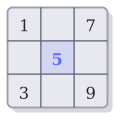
The Pythagorean Square, often called the psychomatrix, is one of the most popular tools in modern numerology. It takes your date of birth, runs it through a short calculation, and arranges the results into a simple 3x3 grid. Each cell holds a number from 1 to 9, and the count of digits in each cell describes a different facet of your character.
In the square it is not which numbers appear that matters most, but how many times each one does.
This guide explains what the square is, how the grid is built step by step, and how to read each cell so you can interpret your own matrix with confidence.
What is the Pythagorean Square?
The Pythagorean Square is a numerology chart that maps your personality onto a grid of nine cells. Unlike a single Life Path number, the square shows your strengths and weak spots across nine separate qualities at once — from willpower and energy to logic, luck and family. The more times a digit repeats, the stronger that trait tends to be.
How the grid is built from your birth date
Building the square involves writing out your birth date and calculating a few additional working numbers, then sorting every resulting digit into its cell.
The four working numbers
- First: the sum of all digits in your full date of birth.
- Second: the sum of the digits of the first number.
- Third: the first number minus twice the first digit of your day of birth.
- Fourth: the sum of the digits of the third number.
Sort every digit of your birth date and these four numbers into the grid. Zeros are ignored — the grid only counts 1 through 9.
The finished grid is arranged in three rows: 1, 4, 7 on top, 2, 5, 8 in the middle, and 3, 6, 9 at the bottom. Doing this by hand is fiddly, so most people use the free Pythagorean Square calculator to build it instantly.
What each cell means
Each cell represents a distinct quality. Here is the traditional meaning of every position.
1 — Character & willpower
How strong and self-assured your personality is.
2 — Energy & vitality
Your reserves of physical and emotional energy.
3 — Interest & curiosity
Your inclination toward science, technology and precision.
4 — Health
Your natural physical resilience.
5 — Logic & intuition
How well you reason and sense outcomes.
6 — Work & skill
Your capacity for hands-on, practical labour.
7 — Luck & talent
Your good fortune and creative gifts.
8 — Duty & responsibility
Your sense of obligation to others.
9 — Memory & mind
Your intellect and ability to remember.
How to read the number counts
Once the grid is filled, you read it by counting. An empty cell points to a quality that is undeveloped or needs attention. One or two digits suggest a balanced, healthy expression. Three, four or more of the same digit suggest that quality is very strongly — sometimes overwhelmingly — present. You can also read the rows, columns and diagonals as lines: a full top row of ones, fours and sevens is associated with strong purpose, while a full diagonal can point to a particular life focus.
Build your own square
The Pythagorean Square is a wonderfully visual way to see your personality at a glance. The quickest way to start is to let the tool do the maths: enter your birth date in the free Pythagorean Square calculator and read your personal grid in seconds.
Numerology is intended for self-discovery and entertainment, not as medical, psychological or financial guidance.